(no subject)
Dec. 25th, 2003 08:11 pm![[personal profile]](https://www.dreamwidth.org/img/silk/identity/user.png) taratemima
taratemimaMore politics for Christmas
A good essay, since I really was worried about overly sensitive 'speech codes' before I went to college, reading all the articles about 'political correctness on campus,' and something that comes to mind concerning college and high school conservatives:
"Finally, how can conservatives claim that speech codes are terrible and that victims of racist abuse should develop a thick skin, and then turn around and shed tears for the conservative student who says nothing about civil rights and abortion because he feels that others might disagree with him? There is an obvious inconsistency here, one that is hardly ever acknowledged. "
It mentions Leo Strauss and the odder parts of his political ideas:
"The great irony behind [Allan, not Harold] Bloom's attacks on bizarre, esoteric, elitist (and probably foreign) intellectual methods is that he would purge deconstruction and feminism from the academy, only to replace them with his own devoutly held set of beliefs about philosophy and interpretation -- a method which to most people would seem even more bizarre, esoteric, elitist (and foreign, for that matter) than anything he criticizes. This method, or school, or ideology -- it is hard to know exactly what to call it -- goes by the name of Straussianism.(73) It is a self-consciously and avowedly elitist philosophy, which works from the premise that there are truths out of the reach of the common man, that these truths are reserved for an elite (or perhaps two complementary elites -- the philosophers and the gentlemen), and that these elites have a responsibility to govern society for the masses who have neither the understanding nor the moral capacity to rule themselves. The Great Books are the source of the truths which enable the gentlemen to rule and the philosophers to guide them -- hence Bloom's repeated, almost hypnotic insistence on the importance of Plato and the post-Socratic philosophers to higher education.(74)"
Straussians, they are like the Missionaria Protectiva in a way:
"Strauss' philosophers realize that the myths of a society (for example, Judeo-Christian religion, conventional morality, romantic love, and the naturalness of the nuclear family) are merely security blankets for the mob, comforting delusions for the vast majority.(84) But they also believe that civilized society depends on these delusions for its survival, and they realize that their privileged position depends on perpetuating the hoax.(85) This means that a Straussian philosopher (particularly a modern Straussian philosopher such as Allan Bloom) is caught in a strange dilemma. As the price of his freedom, he must not reveal that the emperor has no clothes. He must conceal this even from his natural ally, "the gentleman," whose task it is to rule. The philosopher will derive his pleasure from the private knowledge that he is a member of a cabalistic few who can look into the abyss and not blink, a few who realize "nothing is forbidden." In public, however, the philosopher will continue to spout the platitudes and homilies of conventional morality and to defend tradition in education, governance, and family life. The philosopher will seem like a worthy defender of conservative tradition, while he inwardly feels a condescending amusement toward the poor mortals who believe these fairy tales."
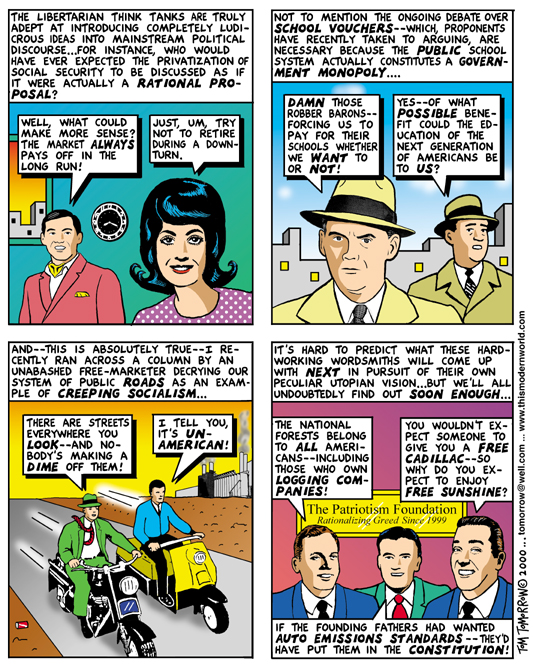
Considering there are a number of neo-cons who are Straussians, and that conservative/libertarian think tanks are influencing economic policy, what are a couple of campus radicals who assign Mumia? Annoying, maybe, but are they the real threat to democracy and American traditions?
A good essay, since I really was worried about overly sensitive 'speech codes' before I went to college, reading all the articles about 'political correctness on campus,' and something that comes to mind concerning college and high school conservatives:
"Finally, how can conservatives claim that speech codes are terrible and that victims of racist abuse should develop a thick skin, and then turn around and shed tears for the conservative student who says nothing about civil rights and abortion because he feels that others might disagree with him? There is an obvious inconsistency here, one that is hardly ever acknowledged. "
It mentions Leo Strauss and the odder parts of his political ideas:
"The great irony behind [Allan, not Harold] Bloom's attacks on bizarre, esoteric, elitist (and probably foreign) intellectual methods is that he would purge deconstruction and feminism from the academy, only to replace them with his own devoutly held set of beliefs about philosophy and interpretation -- a method which to most people would seem even more bizarre, esoteric, elitist (and foreign, for that matter) than anything he criticizes. This method, or school, or ideology -- it is hard to know exactly what to call it -- goes by the name of Straussianism.(73) It is a self-consciously and avowedly elitist philosophy, which works from the premise that there are truths out of the reach of the common man, that these truths are reserved for an elite (or perhaps two complementary elites -- the philosophers and the gentlemen), and that these elites have a responsibility to govern society for the masses who have neither the understanding nor the moral capacity to rule themselves. The Great Books are the source of the truths which enable the gentlemen to rule and the philosophers to guide them -- hence Bloom's repeated, almost hypnotic insistence on the importance of Plato and the post-Socratic philosophers to higher education.(74)"
Straussians, they are like the Missionaria Protectiva in a way:
"Strauss' philosophers realize that the myths of a society (for example, Judeo-Christian religion, conventional morality, romantic love, and the naturalness of the nuclear family) are merely security blankets for the mob, comforting delusions for the vast majority.(84) But they also believe that civilized society depends on these delusions for its survival, and they realize that their privileged position depends on perpetuating the hoax.(85) This means that a Straussian philosopher (particularly a modern Straussian philosopher such as Allan Bloom) is caught in a strange dilemma. As the price of his freedom, he must not reveal that the emperor has no clothes. He must conceal this even from his natural ally, "the gentleman," whose task it is to rule. The philosopher will derive his pleasure from the private knowledge that he is a member of a cabalistic few who can look into the abyss and not blink, a few who realize "nothing is forbidden." In public, however, the philosopher will continue to spout the platitudes and homilies of conventional morality and to defend tradition in education, governance, and family life. The philosopher will seem like a worthy defender of conservative tradition, while he inwardly feels a condescending amusement toward the poor mortals who believe these fairy tales."
Considering there are a number of neo-cons who are Straussians, and that conservative/libertarian think tanks are influencing economic policy, what are a couple of campus radicals who assign Mumia? Annoying, maybe, but are they the real threat to democracy and American traditions?